
The Best Luxury Malaria-Free Safari Lodges for Families in Africa

Updated: 3 hours ago
For families travelling on safari with young children, whether to choose a malaria-free destination can be one of the first significant decisions. Malaria risk varies considerably across Africa, and avoiding it can remove an additional layer of medical planning from a family safari. Importantly, choosing malaria-free does not mean compromising on the experience: some exceptional luxury family safaris, including Big Five reserves, are in malaria-free regions.
We have taken our son on safari across Southern Africa since he was four years old, and our choice to begin with malaria-free reserves was very deliberate. I grew up in South Africa and have spent much of my professional career working in infectious disease and global healthcare, so I understood both the significance of malaria and the additional considerations around prevention and treatment in very young children. When I began planning safaris with my own son, however, I found surprisingly little information that brought the medical, geographical and family-travel considerations together. I researched malaria risk by region and reserve, alongside the quality of the wildlife experience and what actually works for children at different ages. We have since returned to Africa with him repeatedly, and this guide brings together that research with what we have learned first-hand.
Beyond the medical and practical considerations, I also approach family safaris through the lens of Formative Travel™, the belief that thoughtfully chosen experiences can help children develop curiosity, confidence, observation and a deeper understanding of the natural world. A malaria-free safari can provide a wonderful introduction to wildlife, from a young child's first encounters with animals in their natural habitat to the more immersive tracking and conservation experiences available as they grow. For me, choosing the right reserve is as much about what children can discover and learn as it is about where they stay.
Contents
Best Luxury Malaria-Free Safari Lodges for Families in Africa
Gondwana Game Reserve: Best First Malaria-Free Family Safari on the Garden Route
Madikwe Game Reserve: Best Malaria-Free Big Five Safari for Families
Nambiti Private Game Reserve: Best Malaria-Free Safari Near Durban
Wilderness Doro Nawas: Best Malaria-Free Wilderness Safari for Older Children
If you are further along in your planning and looking for a complete guide to luxury family safari across all of South Africa, including regions, age recommendations, packing, health and safety considerations, The Ultimate Guide to a Luxury Family Safari in South Africa covers all of that in one place. I also have a list of the Best Luxury Family-Friendly Lodges in South Africa across both malaria and malaria-free reserves. This post is specifically for families who have decided that malaria-free is the right choice for them right now and want to know which reserves and lodges are genuinely worth it. If you are travelling with a baby or toddler, this article will be valuable. for your trip: Travelling with a Baby and Toddler: What to Pack, What to Rent and What to Leave at Home

Why Choose a Malaria-Free Safari for Families
For families with children under five, a malaria-free safari is the right decision. Managing prophylaxis for a very young child in a remote location adds unnecessary medical complexity to a trip that should be joyful. South Africa has malaria-free reserves with Big Five sightings that match the wildlife quality of any safari destination in Africa.
From age five or six onwards the decision becomes more personal. Many families continue to choose malaria-free as a preference. Others move into the broader safari circuit with appropriate medical advice. Both are valid. What matters is making the decision with full information.
Our son engaged genuinely with safari from age four. By eight he had been on eight safaris across South Africa alone. Each one built on the last. This guide reflects that journey honestly.
Which Safari Regions Carry Malaria Risk and Why They Are Not in This Guide
The most famous safari regions in Africa carry malaria risk. Greater Kruger and its private reserves, Sabi Sands, Kapama, Timbavati, Klaserie, are malaria zones even though the risk is low.
This is also true of large parts of Zimbabwe, including Mana Pools, Hwange and Victoria Falls. Zambia, including South Luangwa, Lower Zambezi and Kafue, carries malaria risk throughout. Mozambique is high risk, particularly along the coast and the Zambezi River Valley.
Botswana’s Okavango Delta and Chobe, which carry high risk from November to June and low to moderate risk for the rest of the year, meaning there is no period when the risk is truly zero. Zimbabwe carries malaria risk throughout its key safari areas including Mana Pools, Hwange and Victoria Falls. Zambia, including South Luangwa, Lower Zambezi and Kafue is a malaria risk destination year round. Mozambique is high risk throughout, particularly along the coast and the Zambezi River Valley. Kenya’s Maasai Mara, Tanzania’s Serengeti and Selous, Uganda’s national parks and Rwanda’s rural areas all carry malaria risk to varying degrees.
This guide is for families who want zero risk, not low risk, not manageable risk, not seasonal risk. Zero. The reserves covered in this guide require no malaria prophylaxis and no medical calculation. You arrive, you safari, and that particular concern is entirely off the table. For families with young children especially, that is not a compromise. It is the point.
These are extraordinary destinations and we have travelled to several of them as a family.. But they are not in this guide because this guide is specifically about luxury malaria-free safari for families.
A note on Damaraland specifically, in the dry season, which runs from May to October, the risk in Damaraland is negligible to zero. The desert environment does not support mosquito breeding without standing water and most travel health advisors treat it as effectively malaria-free during this period. In the rainy season from November to April the risk increases and caution is advised. Plan your visit accordingly and always consult your GP or travel health clinic before travelling.

Best Luxury Malaria-Free Safari Lodges for Families in Africa
Gondwana Game Reserve: Best First Malaria-Free Family Safari Near Cape Town
Gondwana Game Reserve sits in the Garden Route, approximately four hours from Cape Town. No domestic flight. No complex logistics. For families visiting South Africa for the first time, or travelling with young children who need the itinerary to stay manageable, this accessibility is significant.
We visited when our son was five. The reserve is malaria-free with the Big Five (although there are limited leopards on the reserve), a combination that is rarer than most people realise. The fynbos landscape is uniquely South African and unlike the classic bushveld most people associate with safari. Genuinely beautiful and genuinely surprising.
What made Gondwana exceptional for us at that age was the Junior Ranger programme, a structured, genuinely educational experience that gave him his own parallel safari identity alongside ours. Tracking, bush skills, animal identification. He was not simply coming along on an adult experience. He had his own.
The lodge is beautifully designed, the game drives are well managed for young children and the pacing is gentler than the more intense predator reserves. For families starting their malaria-free safari journey, Gondwana is where I would begin.
I've written a full extensive blog about Gondwana Lodge.


Free Guide: Wildlife Experiences That Change a Child's Perspective
A family safari can offer children far more than extraordinary wildlife sightings. Our free guide explores eight remarkable wildlife experiences that encourage curiosity, environmental awareness and a deeper understanding of the natural world.
Madikwe Game Reserve: Best Malaria-Free Big Five Luxury Family Safari
Madikwe sits near the Botswana border in the North West Province, a more remote, authentically wild landscape. Classic bushveld. Vast. Dramatically African in a way that the Garden Route is not. The drive from Johannesburg is about 5 hours and there is an option for a small chartered private flight.
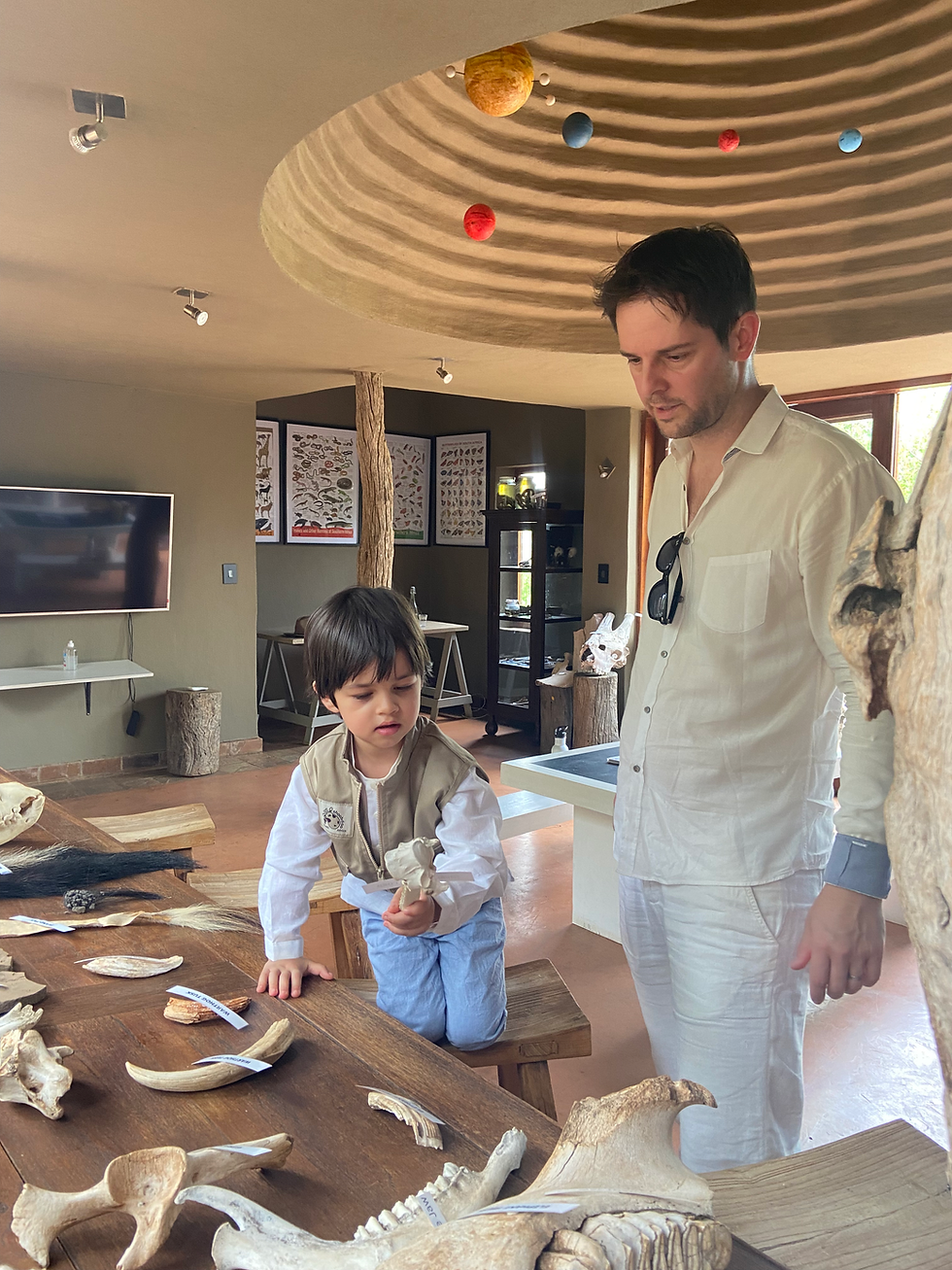
We visited when our son was four and stayed at Lelapa Lodge, which is specifically for families. The food and hospitality at our lodge were genuinely exceptional, not exceptional for a safari lodge, exceptional by any standard. After a long game drive with a four year old, that matters more than you expect it to.
Madikwe is malaria-free and Big Five. It has the most amazing kids club we have seen at a safari lodge to date and excellent family-oriented guides who are genuinely inclusive of children in the experience. It caters for kids to go on 'bumble' drives when they are under the age of 6, which means, slightly later starts than the usual 5.30/6 am, and no exposure to big cats, to avoid risk.
For families wanting a malaria-free luxury family safari with a more remote landscape and a level of food and hospitality that will genuinely surprise them, Madikwe is the answer.
I've written a full extensive blog about Madike Lelapa Lodge.

Explore More of Our African Safari Experiences
From the wildlife-rich reserves of South Africa to Namibia's extraordinary desert landscapes, we've explored some of Africa's most remarkable safari destinations as a family. For more inspiration, discover our firsthand lodge reviews, destination guides and practical advice for planning a luxury family safari.
Nambiti Private Game Reserve: Best Malaria-Free Family Safari Near Durban
Nambiti is the pleasant surprise on this list. Located in KwaZulu-Natal, approximately two hours drive from Durban and 4 hours from Johannesburg. It sits in a part of South Africa that most international families overlook entirely. Beautiful rolling hills and open grassland with an entirely different character from the bushveld of Madikwe or the fynbos of Gondwana.
We visited when our son was six and stayed at Umzolozolo. The reserve is malaria-free with the Big Five. The pace is quieter and less pressured than the more intense predator reserves, which for younger children makes a significant difference. There are couple of other lodges are well set up for families with flexible drive schedules and child-friendly accommodation within the reserve.
For families combining a malaria-free safari with time on the KwaZulu-Natal coast, one of South Africa’s most underrated family destinations, Nambiti makes the combination seamless. Easy from Durban. A genuinely different South Africa. Worth knowing about.


FORMATIVE TRAVEL™
The Young Tracker
Observation · Patience
Explore: My son has been on safari since babyhood. As children grow, invite them to look beyond the Big Five: spot animal tracks, listen for bird calls and ask their ranger what these clues reveal about the wildlife around them.
Reflect: What did you notice when you stopped looking for animals and started looking for signs of them?
Wilderness Doro Nawas: Best Malaria-Free Wilderness Safari for Older Children
Doro Nawas is not a conventional safari. It is something altogether different and understanding that before you go is what allows you to appreciate it fully.
Located in Damaraland, northwest Namibia, the experience here is not about Big Five sightings. It is about space. Silence. The scale of a rocky, desert landscape that has no equivalent anywhere else on earth. Desert-adapted elephants. Ancient geological formations. Skies at night that most children raised in cities have never seen. The drive to Damaraland from Windhoek is approximately 5 hours, from Walvis Bay it is about 4 hours, and there is an option for a small chartered private flight.
This works best for older children, from approximately eight, who can appreciate the landscape itself rather than expecting continuous wildlife sightings. A child who asks questions, who notices things, who can sit with a long silence for desert-adapted animals, that child will be transformed by Damaraland.
Wilderness Doro Nawas as a lodge is exceptional. Beautifully designed, deeply considered, with guides whose knowledge of this specific landscape is extraordinary. Remote enough to require some tolerance for limited connectivity. For families ready for that, it is incomparable.
Malaria note: Damaraland is generally low risk but risk increases during very rainy seasons. Always consult your GP or travel health clinic before travelling.


How to Build Your Malaria-Free Family Safari Journey
Under five years of age: Gondwana or Madikwe. Malaria-free, Big Five, accessible, family-conscious infrastructure.
Five to seven years of age: Add Nambiti if exploring KwaZulu-Natal. Madikwe if food and hospitality matter as much as wildlife.
Eight years onwards: Namibia. Not instead of South Africa. Alongside it. As the next layer of a safari education built over years.
The malaria-free option is not the compromise option. It is where the best family safari journeys begin.
Malaria-Free Safari Age Guide
A note on this age guide: These recommendations reflect the decisions I have made for my own family, informed by my professional background in infectious disease, my understanding of malaria risk and the advice of our healthcare provider. They are intended to explain how I have approached safari travel with my own son, rather than to provide individual medical advice. Malaria risk and the suitability of prophylaxis vary by destination, season, age and individual health circumstances, so families should always seek current advice from their own healthcare professional before travelling.
4 years of age: This is an age at which safari can begin as an introduction to nature and wildlife, without needing to make the experience overly demanding. For us, I would choose a malaria-free safari exclusively at this age, avoiding the additional medical complexity of travelling into a malaria-risk area with a very young child.
4–5 years of age: This is when genuine engagement with safari can begin. Big Five sightings become exciting and memorable, and Junior Ranger programmes and other child-focused activities can work particularly well. I would still strongly recommend choosing a malaria-free reserve at this age.
6–7 years of age: Children can begin engaging more deeply with guides, wildlife, tracking and the wider environment. This is also the age at which some lodges begin allowing children on game drives or sightings involving big cats, although policies vary considerably: some properties set the minimum age at eight, while others may require children to be ten or older. It is therefore important to check the individual lodge’s age restrictions before booking rather than assuming that all safari experiences will be available. Malaria-free remains my preference for many families at this stage.
8+ years of age: By this point, children may be ready for more remote and demanding safari and wilderness environments with vast travel distances, including destinations such as Namibia and Tanzania They can often manage longer drives, more complex itineraries and a deeper level of engagement with guides, wildlife, conservation and the landscape. Lodge restrictions still vary, particularly for activities such as walking safaris and certain wildlife encounters, so these need to be checked individually.
The malaria-free safari is where most family safari journeys should begin. Not because the rest of Africa is not extraordinary, it is, and we have experienced it, but because starting here, with the right reserve and the right lodge, is what builds the relationship between a child and the African wilderness that lasts a lifetime.
Our son was four years old on his first safari. He is nine now and has been on seven in South Africa alone. He falls asleep on long drives and wakes up asking what he missed. He knows the difference between lion tracks and leopard tracks. He understands why you do not leave the vehicle. He has watched elephants in the water at Jabulani and eaten better food than most adults in the middle of the Madikwe bush. None of that began in a malaria zone.
It began exactly where this guide begins, with a careful first choice that made him want to come back.
Start here. Come back often. Africa will do the rest.
Shanti
The Kensington Diary




Comments