
A Luxury Family Galápagos Cruise: The Ultimate Wildlife Experience?“There are very few places in the world where you can spend the morning walking amongst extraordinary wildlife, swim with sea lions

“There are very few places in the world where you can spend the morning walking amongst extraordinary wildlife, swim with sea lions and turtles in the afternoon, and still be back onboard in time for hot chocolate.”
I have travelled to more than 60 countries and experienced some extraordinary wildlife encounters over the years, from safaris in Africa to swimming with whale sharks and manta rays on Ningaloo Reef in Australia. The Galápagos had been high on my list for years, but it is also one of the most expensive wildlife trips we have taken as a family, which inevitably made me wonder whether the reality could possibly live up to everything I had read about it. There are some journeys where the cost itself raises the bar considerably, and this was definitely one of them.
Seven nights sailing on a luxury family Galapagos cruise through the islands with Ecoventura on Theory answered that question fairly quickly.
The Galápagos is unlike almost anywhere else we have travelled because the wildlife isn't simply something you go out looking for. It is everywhere. Sea lions lie across beaches you would happily travel halfway around the world to visit even if there wasn't an animal in sight. Marine iguanas cover black volcanic rocks. Giant tortoises wander through the Highlands. Birds nest remarkably close to the walking trails, while beneath the water there are turtles, rays, sharks, sea lions, penguins and huge schools of fish.
On one snorkel, I was adjusting my camera when a Galápagos penguin suddenly swam directly underneath me. Only one other person in our group saw it, and by some miracle I actually managed to catch it on camera. There is something particularly satisfying about capturing a moment nobody else believes quite happened until you have photographic evidence.
Our son had his own wish list. He had recently turned nine and desperately wanted to see hammerhead sharks. We eventually did, which probably mattered considerably more to him than almost anything else on the itinerary.
Yet some of my favourite memories weren't the headline wildlife encounters at all. They were of him playing on the beaches.
That surprised me, because when I first looked at Ecoventura's different routes, I wasn't entirely convinced we had chosen the right one. We were travelling on their seven-night Beaches and Bays itinerary, and there was a part of me that wondered whether we should have selected an itinerary that sounded more heavily weighted towards wildlife. I particularly wanted to see marine iguanas swimming underwater, and I was mentally comparing what appeared on each route before we had even arrived.
Then we reached the beaches.
Some were genuinely amongst the most beautiful I have seen anywhere in the world. The colour of the water reminded me of the Maldives or Seychelles, with beautiful stretches of sand and almost impossibly clear sea, except that here you might have sea lions lying on the beach, marine iguanas on the rocks and bright red Sally Lightfoot crabs appearing around you.
Our son couldn't have cared less whether that particular morning ticked another species off my imaginary list. He wanted to get into the water and play. So did the other children.
Watching them reminded me of something I occasionally forget when planning ambitious trips. Adults can become very focused on maximising an itinerary. Children often experience a place completely differently. A spectacular beach where they are given time to swim and play may matter every bit as much as the wildlife encounter we have travelled thousands of miles to see.
By the end of the week, I was very glad we had chosen Beaches and Bays. It gave us both.

Getting From Quito for a Luxury Family Galapagos Cruise
We began this part of our Ecuador journey in Quito, taking the domestic flight to San Cristóbal, where Ecoventura's Beaches and Bays itinerary begins. The flight travels via Guayaquil, where there is a short stop before continuing to the Galápagos, although you remain on the aircraft, so it is considerably easier than the routing initially sounds.
From Quito, the journey takes around three and a half hours in total. Ecoventura manages the Galápagos arrangements, and once we arrived in San Cristóbal we were met and transferred to the harbour before taking our first Zodiac out to Theory.
I would book these flights as early as possible, particularly if you are travelling during school holidays. Flights from mainland Ecuador to the Galápagos can be around £300–£400 per person, but fares can climb considerably when availability becomes limited. It is one of those costs that is easy to overlook when you first see the price of the cruise itself, but for a family it becomes a meaningful additional part of the overall budget.
From that point onwards, one of the things I appreciated most about travelling through the Galápagos by yacht became apparent very quickly. You stop wasting time getting places.
On a land-based holiday, you inevitably spend part of each day travelling from your hotel to the day's activity. In the Galápagos, where different islands offer different wildlife and landscapes, that can involve boats, transfers and excursions organised through different providers. On Theory, the yacht simply moved with us.
Much of the longer sailing happened overnight, which meant we would go to bed in one location and wake up already positioned for the following morning's excursion. We would have breakfast, collect whatever we needed, climb into the Zodiac and often be at the beach or landing point within two or three minutes.
With a child, this is a bigger luxury than it sounds.
With a luxury family Galapagos cruise, there was no packing and unpacking every couple of days, no repeatedly checking whether everyone had remembered everything before a transfer, and very little of the logistical dead time that can slowly eat into a family holiday. The staff seemed to have everything running like clockwork without making the experience itself feel rigid.
That combination became one of the things I liked most about Ecoventura. The complicated parts happened around us almost invisibly, leaving us to concentrate on what we had actually come to the Galápagos to do.

Choosing Your Ecoventura Luxury Family Galápagos Cruise
One thing I hadn't fully appreciated before planning this trip was how much the itinerary matters.
Ecoventura operates two different seven-night routes through the Galápagos: Beaches and Bays, which explores the Southern and Central islands, and Volcanic Wonders, which takes you through a different part of the archipelago. Both sail aboard Ecoventura's three sister yachts, Origin, Theory and Evolve.
There are so many islands in the Galápagos, and they are not interchangeable. Different islands have different landscapes, habitats and wildlife, so choosing a cruise isn't simply a question of finding the yacht or dates you prefer. It is worth looking carefully at which species and experiences matter most to you and then working backwards to the itinerary that includes them.
We chose Beaches and Bays aboard Theory, which took us through islands including San Cristóbal, Española, Floreana and the Central Galápagos. It combined some of the wildlife I most wanted to see with beautiful beaches and a lot of opportunities to snorkel and swim, something that ultimately made it particularly well suited to us as a family. I wasn't completely convinced we had made the right choice at first, but I'll come back to why later in the article.

Life Aboard Ecoventura Theory
Theory is a small luxury expedition yacht rather than a conventional cruise ship, and I think that distinction is important. It is intimate enough that you quickly get to know the other guests, naturalists and crew, while still having enough space to disappear with a book or sit quietly outside when you want some time to yourself.
We booked our trip unusually late, which meant the connecting cabins I would probably have chosen for a family were no longer available. Instead, the three of us shared one cabin.
I won't pretend it was enormous. It wasn't. We had a large king-size bed and our son's bed was positioned slightly above ours in the corner, which naturally meant that he thought he had secured by far the best bed in the room. Privacy was limited, but it worked far better than I had expected, partly because we spent so little of the day inside the cabin anyway. There was also really good storage for both luggage and clothing which gave the room far more space than meets the eye.
The rooms themselves are beautifully finished and felt properly luxurious rather than functional expedition accommodation. More importantly, after spending much of the day swimming, hiking, climbing in and out of Zodiacs and generally being outside, all we really wanted by bedtime was an excellent shower and a comfortable bed.
There is also a gym onboard. I saw it. That was approximately the extent of my relationship with it.
Between the hiking, walking, swimming and snorkelling, we were moving for hours every day, which fortunately also compensated for the frankly impressive amount of food we managed to consume.
The hot tub received considerably more attention from our family. Our son would happily have spent every available break in it, and those couple of hours between activities became an important part of the rhythm of the day. People would read, nap, sit outside or simply do nothing for a while before the next excursion.
That downtime is important because the days are full. Not exhausting, but full.

What a Typical Day in the Galápagos Actually Looks Like
Most mornings began with an excursion. Depending on the island, we might take the Zodiac to a beach, make a dry or wet landing for a guided walk, explore a bay or combine several of those things while looking for wildlife.
The naturalists accompanied us throughout and were exceptional. We had two guides during our journey who were quite different in personality and style. One was particularly personable and naturally engaging with the group, while the other had an extraordinary depth of knowledge about the history, geology and wildlife of the islands. Both had spent many years working in the Galápagos, and that experience showed.

One of the things I hadn't understood before visiting was how strictly tourism is controlled within the National Park. You don't simply wander around an island for as long as you feel like it. Landings, routes and timings are carefully managed, and the naturalists are constantly conscious of where the group can go, how long you can remain and how closely you can approach wildlife.
For a child, I thought this was particularly valuable because conservation stopped being an abstract concept. There were rules, and the rules weren't there for our convenience. We were entering the animals' environment and therefore had to behave accordingly.

After the morning excursion we would return to Theory, often only a couple of minutes away by Zodiac, for lunch. It generally gave us our longest break, often around two or three hours. This was when our son would make his bid for the hot tub, while the adults tended to read, sleep or sit outside. You didn't have to attend every excursion, and occasionally people chose to remain onboard.

Then we headed out again later for snorkelling. On some days the morning itself combined several experiences, while on others the snorkel came separately.
We attended almost everything. Partly because we wanted to make the most of being there and partly because wildlife has an irritating habit of producing the best encounter on the one excursion you nearly decided to skip.

Later in the afternoon we would head out again, perhaps for another wildlife walk, a hike, a beach landing or a Zodiac excursion. We would return to the yacht around sunset for drinks and snacks before getting ready for the evening briefing.

The briefing usually lasted around half an hour and covered the next day's route, wildlife, activities and what we needed to bring. By the end of the week, some of the children were understandably beginning to look slightly less enthusiastic when briefing time arrived. The adults generally attended regardless because it was genuinely useful to know what the next day involved.

Then we had dinner. And dinner deserves considerably more than a passing mention.
The Food on Ecoventura Theory
Theory is part of Relais & Châteaux, and the food was exceptional throughout the entire week.
Not exceptional “for a boat”. Exceptional.
Seafood in particular was cooked with a consistency I rarely encounter even in very good restaurants. Over seven nights we ate different fish, prawns, calamari, grouper and other locally inspired seafood dishes, and I genuinely cannot remember being served one piece of fish that was overcooked.

The Ecuadorian prawn ceviche was one of my favourites. We discovered Ecuadorian-style ceviche properly on this trip and continued ordering it afterwards because it was so good.
What also impressed me was how wholesome the food remained despite the quantity of it. We were eating extremely well three times a day, plus snacks, yet meals never felt relentlessly rich or heavy. There were plenty of fresh ingredients, seafood and lighter options alongside the things you inevitably decide you deserve after spending half the morning swimming.

Breakfast was served buffet style, with fruit, breads, pastries, cereals and hot options, while eggs and omelettes could also be prepared to order. We occasionally ordered from the à la carte selection, although on mornings when we had allowed ourselves every possible extra minute in bed, the buffet was considerably more practical.
Lunch was also buffet style and varied every day. Fresh salads, soups, hot options and breads.
Dinner was more formal and served à la carte, with a set multi-course menu offering choices for each course. There was an amuse-bouche beforehand, different options for starters and mains and a choice of desserts.

Then there were the snacks. There seemed to be a steady supply of them throughout the day, ranging from sensible healthy options to Ecuadorian chocolate, crisps, and biscuits, which we approached with considerably less restraint. Ecuador produces some exceptional cacao, and there were chocolates with very high cocoa percentages alongside sweeter options. Drinks from the regular bar, teas and other refreshments were included, with premium alcohol charged separately.
My favourite food-related ritual, however, came after snorkelling. We would return wet, climb back aboard, start wrestling ourselves out of our wetsuits and be greeted with hot chocolate.
The crew helped enormously with the whole process. Our snorkelling equipment was allocated for the week, wetsuits were provided, and staff were constantly there to help take equipment, store it and get everyone organised for the next excursion. You were still responsible for knowing where your own fins and equipment were, but the tedious part of dealing with wet gear after every snorkel somehow disappeared.
By about day three, the hot chocolate waiting at the end had become part of the experience. We ate an astonishing amount during those seven days. The reassuring part was that we were also so active that none of us gained weight. I am choosing to regard that as one of Ecoventura's lesser advertised benefits.
Snorkelling, Hammerheads and a Nine-Year-Old Who Didn't Want to Get Out
Our son had turned nine only a few days before we arrived in the Galápagos and was already a reasonably confident swimmer. That mattered.
The previous year, on Ningaloo Reef in Western Australia, he had swum with a whale shark and manta rays. He had done it, but he had been frightened. I remember the combination of nerves beforehand and enormous pride afterwards because he knew he had pushed himself to do something that genuinely scared him.
The Galápagos showed me what can happen when that first difficult experience is followed by repetition. We weren't snorkelling once. We were doing it again and again across different locations, in different conditions and with different wildlife.
At the beginning of the week he was already capable. By the end, his confidence had changed noticeably. He was frequently one of the fastest swimmers in the group, including the adults, and had started diving further beneath the surface rather than remaining at the top of the water.
He wasn't being taught confidence. He was accumulating evidence that he could handle the environment. That distinction is one of the reasons I think experiences like this can be so formative for children. Confidence is very difficult to give someone through reassurance alone. It becomes much more robust when a child has repeatedly done something themselves and knows, from experience, that they can manage it.
For him, seeing hammerheads was the highlight. He had wanted to see them before we arrived, and when we finally did, the excitement was exactly what you would expect from a nine-year-old who had spent days talking about sharks.
For me, one of the most extraordinary encounters happened almost accidentally. I was adjusting my camera during a snorkel when a Galápagos penguin, this rarity that lives along the Equator, suddenly appeared and swam directly beneath me. Only two people in our group saw it. I was incredibly lucky to catch it on camera because within seconds it had disappeared.
We also swam close to sea turtles, which behaved completely differently from many turtles I have encountered elsewhere. They didn't immediately retreat when we appeared. They continued moving around us with an extraordinary lack of concern.
There were eagle rays, nurse sharks, sea lions constantly appearing around us and huge schools of fish.
Sea lions were perhaps the most entertaining because they were so curious. They would swim towards us, turn and disappear before appearing again somewhere else, sometimes seemingly more interested in the strange humans attempting to keep up with them than we were in them.

By the end of the week, our son wasn't simply tolerating the amount of time we were spending in the water. He was protesting when we had to leave. “Why do we have to go?” And then: “I wish I could stay here and snorkel every day.” For me, that was probably the clearest indication that seven nights had not been too long.
Why the Beaches and Bays Itinerary Worked So Well for Us
By the middle of the week, any doubts I had about choosing Ecoventura's Beaches and Bays itinerary had disappeared. What initially sounded as though it might be the softer option turned out to offer exactly the balance we needed as a family.
The wildlife was still extraordinary, but the experience wasn't relentless. Some mornings were about walking slowly through an island with our naturalists, looking at birds, iguanas and the landscape around us. Others took us into the water. Then there were the beaches, where there was absolutely nothing our son needed to achieve or learn. He could simply run into the sea and play.

I think that balance matters more with children than we sometimes acknowledge. I am quite capable of planning a family trip as though I am organising a military operation, particularly when there is a lot I want to see. There is always the temptation to think that if we have travelled this far, we should squeeze every possible experience out of every day. The Galápagos reminded me that children don't necessarily measure the success of a trip by how many significant things they have seen.
Sometimes they just want to play. And when the place they are playing happens to be a beach that looks as though it belongs in the Seychelles, with sea lions metres away and marine iguanas on the rocks, I am not sure anyone is losing out.
There was also something wonderful about the contrast. We could spend part of the day concentrating intensely on wildlife with our naturalists and then arrive somewhere where the experience became completely instinctive. Shoes off. Into the water. Explore the rocks. Look at the crabs. Watch the sea lions. Swim.
For our son, those were not lesser moments in between the important ones. They were part of what made the week so enjoyable.
Seven Days, and Islands That Never Felt the Same
Before travelling to the Galápagos, I don't think I fully understood how important the itinerary would be.
It is tempting to think of the archipelago as one destination, particularly when you are planning from London and looking at a map of relatively small islands scattered across the Pacific. In reality, moving between them begins to feel like travelling through a series of related but distinct worlds.
There is some overlap in wildlife. Sea lions, thankfully, seemed to appear everywhere and quickly became part of the scenery. But many species are associated with particular habitats and islands, which means that the route you choose genuinely shapes the wildlife experience you will have.

It is worth remembering, though, that wildlife is never guaranteed. We were exceptionally lucky to see hammerheads while snorkelling, for example, but that was not something our itinerary could promise. If there is a particular species you are especially hoping to see, it is worth understanding which islands and habitats give you the best chance of encountering it and choosing your route accordingly. Even then, these are wild animals, and part of the experience is accepting that they may or may not appear.
Española was one of the places I had particularly wanted to visit because of the waved albatross. We travelled in July, when they were present, and seeing them in the landscape rather than simply knowing about them was extraordinary. Like so many of the birds in the Galápagos, their apparent indifference to humans allowed us to observe behaviour at a proximity that would be almost impossible in many other parts of the world.

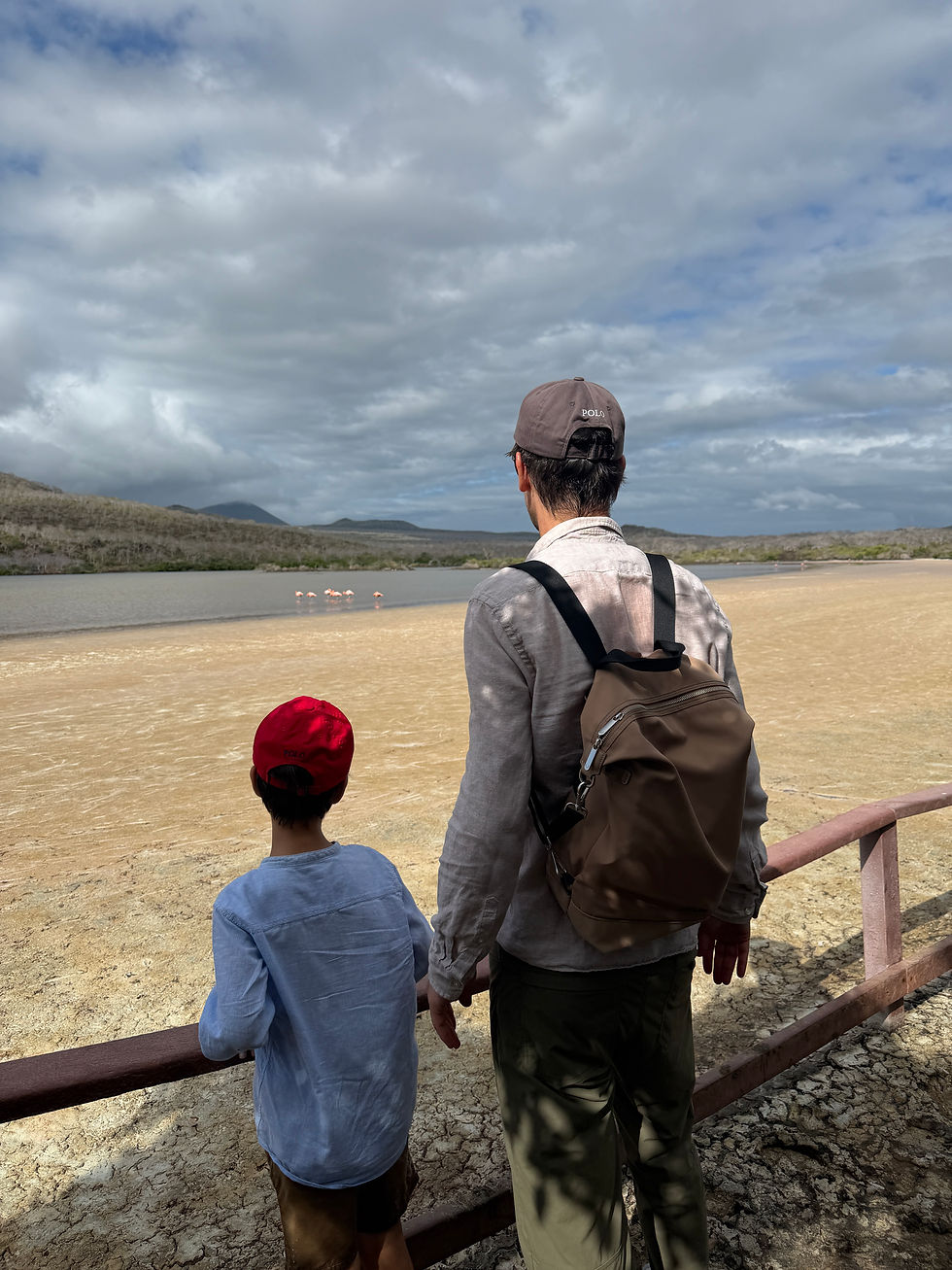
Elsewhere we encountered blue and red footed boobies, flamingos, giant tortoises, marine iguanas, land iguanas and the extraordinary collection of seabirds that make the islands feel so alive. Underwater, the landscape changed again. Some snorkelling sites were filled with fish; others brought turtles, rays, sea lions, sharks or the possibility of seeing one of the tiny Galápagos penguins.


The final couple of days produced some of my favourite encounters of the entire week. By then we had already seen so much that I might have expected the novelty to wear off. Instead, the opposite happened. We were getting better at noticing things. That is another benefit of spending seven nights here.
On the first day, almost everything commands your attention because everything is unfamiliar. A few days later, you begin looking more carefully. You start recognising animals you have already encountered. You understand a little more of what the naturalists are describing. Our son began making connections between things he had seen on previous islands rather than experiencing each excursion as something completely separate.
Travel can sometimes become an accumulation of spectacular moments, particularly when children are involved and we are eager to show them as much of the world as possible. What I liked about the Galápagos was that the repetition slowed that process down. We weren't seeing an animal once, taking a photograph and moving on forever.
We had time to become familiar with the environment.
Floreana, Eden and the Stranger Side of the Galápagos
One of the unexpected pleasures of the week was discovering how fascinating the human history of the Galápagos is.
Floreana in particular has one of those histories that becomes increasingly bizarre the more you read about it. In the 1930s, a small group of European settlers arrived on the island seeking various versions of an idyllic life away from civilisation. What followed involved an eccentric self-proclaimed baroness, complicated relationships, disappearances and deaths that have never been entirely explained.
The story has since inspired Eden, the film with Jude Law and Ana de Armas, based on those events, and once we began talking about it onboard, several of us started reading more about what had actually happened.
Theory has a library, which suddenly became considerably more interesting.

I love when this happens during travel because it is exactly how curiosity tends to work in real life. You encounter a place first, hear a story you knew nothing about and then want to understand it properly.
Our son wasn't sitting down for a lesson on twentieth-century Galápagos history. He was overhearing conversations, asking questions and beginning to understand that these islands had a human story as strange in places as their natural one.
For me, this is another part of formative travel that is easy to overlook. Not everything needs to produce a measurable skill. Sometimes a place simply opens another door in a child's understanding of the world.
One question leads to another, which leads to a book, a conversation or something they remember months later for reasons you could never have planned in advance. The fact that we were onboard for seven nights gave us space for that to happen.
July in the Galápagos
We travelled in July and, for us, the conditions were almost perfect.
It was warm enough to spend large parts of every day outside without the heat feeling oppressive, and the sun wasn't constantly beating down in the way I had imagined when thinking about somewhere sitting directly on the Equator.
That does not mean the sun should be underestimated. Ecoventura and the naturalists were extremely clear about sun protection. You are exposed to equatorial UV even when the temperature feels comfortable or there is cloud cover, and we were repeatedly reminded to use plenty of sunscreen and cover up.
Long sleeves became our default for many of the walks, and I would absolutely recommend proper sun-protective clothing for children rather than relying entirely on sunscreen. We also wore wetsuits for snorkelling, which Ecoventura provided for the duration of the cruise. The water temperature in July was comfortable for us and our son never complained about being cold, even though we spent a significant amount of time in the water.
The combination suited us extremely well. We could hike without feeling as though we were melting, spend long periods outside and still swim comfortably.

What About Seasickness?
This was one of my biggest practical concerns before the trip because both my son and I are very prone to motion sickness. And I mean very prone.
I had therefore arrived in Ecuador with enough motion sickness medication to suggest we were preparing to cross the Pacific ourselves. We took it for the first couple of nights because I was determined not to discover the hard way that we needed it. Then we gradually realised neither of us was feeling sick. So we stopped. We didn't need it again.
Obviously, this is only our experience and sea conditions vary, so I would never suggest that someone who suffers from motion sickness should travel without medication. I would absolutely take it again. But I had worried that seven nights sleeping on a yacht might become difficult for us, and it simply wasn't.
Part of the reason the journey felt so comfortable was that much of the longer navigation happened while we were sleeping. During the day, Theory was generally positioned close to the locations we were exploring, and the Zodiac journeys themselves were usually incredibly short.
For anyone who loves wildlife but has dismissed a Galápagos cruise because they are worried about motion sickness, I would not automatically rule it out. Speak to your doctor about the appropriate medication, travel prepared and consider the time of year and vessel carefully. I was considerably more anxious about it beforehand than I needed to be.

Is Six Really the Right Age for Ecoventura?
Ecoventura accepts children from the age of six, but I don't think age alone is the best way to decide whether a child is ready for a week like this.
Our son had just turned nine. He was a strong swimmer, had snorkelled in open water before, was comfortable around wildlife and genuinely wanted to participate in almost everything we were doing.
That made a difference.
Another child travelling with us was older, around ten or eleven, and although he joined several of the snorkelling excursions, he didn't feel comfortable doing one of the deeper open-water snorkels towards the end of the trip. He simply chose not to go.
I actually think that is worth mentioning because there can be a tendency with family adventure travel to treat children's ages as though they are capability ratings. They aren't.
One six-year-old may happily jump into open water surrounded by fish while another eleven-year-old finds the same situation overwhelming. One child will happily walk for hours looking for wildlife while another will become bored after twenty minutes. Neither response makes one child better or more capable than the other. They simply have different starting points.
If I were considering Ecoventura with a younger child, I would think less about whether they had reached the minimum age and more about their individual baseline. Are they reasonably confident in the water? Have they snorkelled before? Are they comfortable getting on and off small boats? Do they enjoy wildlife? How do they respond when plans change or when an experience doesn't produce an immediate reward? Are they physically comfortable walking in heat and over uneven ground? Are they likely to enjoy several activities in a day?
They don't need to arrive already capable of everything. That would rather defeat the point.
But there needs to be enough of a foundation for the challenges to stretch them rather than overwhelm them.
Our son's previous experience on Ningaloo Reef is a good example. Swimming with a whale shark the year before had frightened him. He still did it, and afterwards the sense of achievement was enormous. That experience became part of the baseline he brought into the Galápagos.
A year later, we watched the next stage happen. He didn't simply repeat what he had already done. He became more confident, started diving more deeply and moved through open water with considerably less fear. Capability builds on capability. Travel gives children unusually vivid environments in which to practise it.
Why I Consider the Galápagos Formative Travel
I am increasingly interested in the difference between a holiday children remember and an experience that may actually shape something in them. The two can obviously coexist.
I use the term Formative Travel to describe experiences that create opportunities for children to develop things such as judgement, confidence, adaptability, perspective, patience and an understanding of the world beyond their normal environment. It does not mean turning travel into school, filling every day with educational activities or interrogating children afterwards about what they have learnt.
I would hate that.
The Galápagos worked precisely because none of those things needed to be manufactured.
The environment did much of the work.
Wildlife teaches patience because it doesn't appear on command. Snorkelling develops confidence because children have to operate in an environment they cannot completely control. Repeatedly preparing for excursions gives them responsibility for their own belongings and equipment. Walking through protected environments requires them to follow rules that exist for the benefit of something other than themselves.
The naturalists added knowledge to what our son could already see in front of him, but the learning remained rooted in experience.
Perhaps most importantly, the Galápagos repeatedly put us in situations where humans were not at the centre of the story. That is surprisingly powerful for children.
So much of modern childhood is designed around immediate responsiveness. Entertainment begins when they press a button. Information appears when they ask for it. Activities are organised around them. Adults spend enormous amounts of energy making childhood safe, predictable and stimulating.
A wild animal has absolutely no interest in any of that.
You can travel thousands of miles hoping to see something and it may not appear.
Then a penguin can swim underneath you while you're busy doing something else.
You learn to watch rather than demand.
You learn that uncertainty can produce excitement rather than anxiety.
And you begin to understand that entering a wild environment requires adapting your behaviour to it, rather than expecting the environment to adapt to you.
For me, that is one of the most valuable things wildlife travel can offer a child.
Luxury and Formative Travel Are Not Opposites
There is another reason Ecoventura interested me from a Formative Travel perspective.
This was unquestionably a luxury experience. We were sleeping in a beautifully designed cabin, eating Relais & Châteaux food, returning from snorkelling to hot chocolate and having a team of staff quietly taking care of almost every logistical detail around us. Yet our son wasn't passive.
That distinction matters. There is a version of luxury family travel where so much is done for children that they barely need to engage with their own experience. Everything is anticipated, entertainment is constant and any friction is removed before they encounter it.
That isn't what happened here. Ecoventura removed the friction that didn't add value.
We didn't need to spend hours organising boats, carrying wet equipment around hotels, arranging guides, coordinating transfers between islands or working out where we were eating after a long day.
But nobody could snorkel for our son.
Nobody could climb into the Zodiac for him.
Nobody could make him listen to the naturalist, walk the trail, manage his own fins, become comfortable in open water or decide whether he was brave enough to swim when sharks were somewhere below us.
The luxury supported participation rather than replacing it.
That, for me, is an important distinction when travelling with children. I don't believe meaningful travel requires unnecessary discomfort. Children don't become more capable because the hotel bed is uncomfortable or their parents have spent three hours trying to organise a transfer. The challenge needs to sit in the right place. On this trip, it did.
Why Seven Nights Was Important
There are shorter ways to experience the Galápagos, but personally I am very glad we chose seven nights.
The difference is not simply that you see more islands or potentially more wildlife. You have time for the unfamiliar to become familiar.
On the first day, getting into a Zodiac is an event. By the end of the week, everyone knows the routine.
The first snorkel requires more organisation. Several days later, your child knows where his equipment is, what he needs and what happens when he gets back onboard.
The first sea lion creates enormous excitement. Later, you begin watching its behaviour. The first explanation from a naturalist is completely new information. By day five or six, something they say connects with an animal or geological feature you saw three islands ago. This is one of the reasons I am wary of travel becoming a race to expose children to as many destinations as possible.
Exposure is not the same as depth. Sometimes the formative part comes from staying with an experience for long enough that a child moves beyond novelty. Seven nights gave us that. It also allowed us to have ordinary moments inside an extraordinary journey. Our son had time to play on beaches rather than constantly being moved onto the next significant experience. We could sit in the hot tub. Read. Eat far too much Ecuadorian chocolate. Talk about the strange history of Floreana. Get excited about tomorrow's sharks. Those moments are not wasted time. They are often when a trip begins to belong to a child rather than simply being something their parents have arranged for them.

Planning a Galápagos Cruise With Ecoventura
The first thing I would do differently is book earlier.
We arranged this journey relatively late, which is why we ended up sharing one cabin rather than booking connecting accommodation. It worked perfectly well for us, but if room configuration matters to your family, I would not leave it to chance. These are small yachts with only a limited number of cabins, so once a particular configuration has gone, there simply isn't the inventory of a large hotel or cruise ship to fall back on.
Popular periods also fill quickly. July is a particularly attractive time for families because it coincides with school holidays and, in our experience, offered excellent conditions for being active outdoors.
I would also think carefully about the itinerary rather than choosing purely according to the yacht or available dates. Different Galápagos routes offer different wildlife, and it is worth deciding which species and landscapes matter most to your family before booking.
Then there is the cost, because there is no getting around the fact that this is an expensive trip. Ecoventura's seven-night cruises currently cost around US$11,000 per person, depending on cabin configuration, before you factor in the flights to the Galápagos and any time you spend elsewhere in Ecuador. For a family, that becomes a very significant investment.
I do think it is important, however, to understand what that price is buying. For seven nights, the yacht is both your hotel and your transport between the islands, with much of that travelling happening while you sleep. Your meals, most drinks, naturalist-led excursions, Zodiac journeys, snorkelling equipment and wetsuits are included, and you are generally going out to explore several times a day. It is still an expensive way to travel, but having experienced it, I would choose the expedition cruise again because so much of what makes the Galápagos extraordinary is the ability to move between very different islands and habitats rather than experiencing the archipelago from one fixed base.
For us, Beaches and Bays turned out to be an excellent choice precisely because it balanced significant wildlife encounters with beautiful beaches and opportunities for our son simply to enjoy being in the water.

We actually considered adding another two or three nights on Santa Cruz after the cruise, and I can see a reason for doing that if there is something very specific you want to experience that isn't covered by your itinerary. Staying on one of the inhabited islands gives you access to additional day trips,
snorkelling and diving sites, so it can be a useful way of supplementing rather than repeating the cruise.
I wouldn't add extra nights simply because you feel seven nights aboard a yacht somehow isn't enough. For us, it absolutely was. If I were spending more time and money, I would start with the wildlife or underwater experience I particularly wanted and then work backwards to where I needed to stay to access it. That is also why I would prioritise the expedition cruise first and use a land stay selectively around it, rather than trying to recreate the same experience through a series of day trips from one island.
If you are travelling with children, I would also prepare them for snorkelling before arriving if possible. You don't want the first time they put on a mask and snorkel to be when everyone else is climbing into a Zodiac for an open-water excursion.
Likewise, bring serious sun protection. Long-sleeved UV clothing, hats and high-factor sunscreen are essential even when the temperature doesn't feel particularly hot. The great news is that I picked up a few tops at the Quito airport which had more suitable clothing than I could find in store or online in the UK.
Wetsuits and snorkelling equipment were provided for us onboard and remained allocated to us throughout the week, which made the repeated excursions remarkably straightforward. They also have telescopes in the room.
And if you are prone to motion sickness, take whatever medication or precautions you would normally use rather than assuming a luxury yacht somehow makes you immune. We packed plenty, used ours initially and then discovered we were completely comfortable without it. I would still pack exactly the same amount next time. I would rather return home with unused motion sickness tablets than spend seven nights wishing I had brought them.
One of the Best Luxury Wildlife Experiences We Have Had
By the end of seven nights aboard Theory, what stayed with me wasn't one single encounter. It wasn't even the penguin swimming underneath me, although I will probably be telling that story for years. It was the accumulation of everything.
The beaches that made me stop questioning whether we had chosen the right itinerary. The hammerheads our son had desperately wanted to see. The sea lions that seemed to be everywhere. The turtles swimming astonishingly close to us. The flamingos, albatrosses and marine iguanas. The naturalists explaining why one island looked and behaved so differently from the next.
Then there were the less obvious memories.
Our son trying to negotiate more time in the hot tub. Hot chocolate after snorkelling. Everyone becoming increasingly invested in the strange story of Floreana. The evening briefings that the children became progressively less interested in attending. Eating far more than seemed sensible and somehow getting away with it because we were moving constantly.
Those are the things that make a journey feel like ours rather than simply an itinerary we completed.
Ecoventura made an extraordinarily complex destination feel remarkably easy to experience. Theory moved between islands while we slept, the crew took care of the logistics, the naturalists gave context to what we were seeing and the yacht gave us somewhere genuinely luxurious to return to between excursions.
But the Galápagos itself was never made easy in the sense of becoming passive. We still had to get into the water. We still had to walk, wait, watch and participate. Our son arrived having already done some extraordinary things in the water, but still carrying some of the fear he had experienced the previous year. Seven days later, he was diving beneath the surface, swimming ahead of adults and complaining because the final snorkel had to end.
“I wish I could stay here and snorkel every day.”
He has already decided that next time he wants to dive Darwin and Wolf, with their huge schools of hammerheads and the possibility of whale sharks. He also knows those waters demand considerably more diving experience, so he has set himself a target of 40 logged dives before we go. At five to ten dives a year, he has calculated that he should be ready at around eighteen. Apparently, our return to the Galápagos now has a five-year training plan.
For a nine-year-old, I think that probably says more about the experience than anything I could write.
For me, the Galápagos reinforced something I have been thinking about increasingly as our son gets older. The most formative family experiences are not necessarily the ones where children are taught the most. Often, they are the ones where the environment asks more of them.
The Galápagos asked him to be curious, physically engaged, patient, observant and increasingly independent. Ecoventura gave us enough comfort and expertise around that experience that we could allow him to do those things without spending our own days managing the logistics.
After travelling to more than 50 countries, I would place our seven nights aboard Ecoventura Theory amongst the finest luxury wildlife experiences we have had as a family. Not because everything was perfect or because we saw every animal it is possible to see in the Galápagos. We didn't.
It was because for seven days, wildlife wasn't something we fitted into our holiday. Our holiday fitted around the wildlife.
And I think that is what made the Galápagos so extraordinary.

Planning Your Own Galápagos Journey
If you're considering the Galápagos, I'd be delighted to help.
I recently launched my Formative Travel Advisory, through which I can help families plan and book journeys like this one. I am registered with Little Emperors and work within their Virtuoso-aligned luxury travel network, combining their preferred hotel and travel relationships with my own approach to planning family travel around the ages, interests and capabilities of the children travelling.
The Galápagos is a particularly good example of where that planning matters. Ecoventura operates two very different seven-night itineraries, and I can help you decide which route, yacht and cabin configuration best suits your family, as well as how to incorporate the islands into a wider Ecuador journey. Having now travelled through the Galápagos, Amazon and Andean Highlands ourselves, I can also advise from firsthand experience on how to combine them and where I think it is worth spending your time.
If you'd like me to help plan and book your Galápagos or wider Ecuador journey, simply get in touch through the Formative Travel Advisory enquiry form or email me directly at hello@thekensingtondiary.com. I'd love to help you create your own version of this extraordinary
journey.
Shanti
The Kensington Diary


Comments